
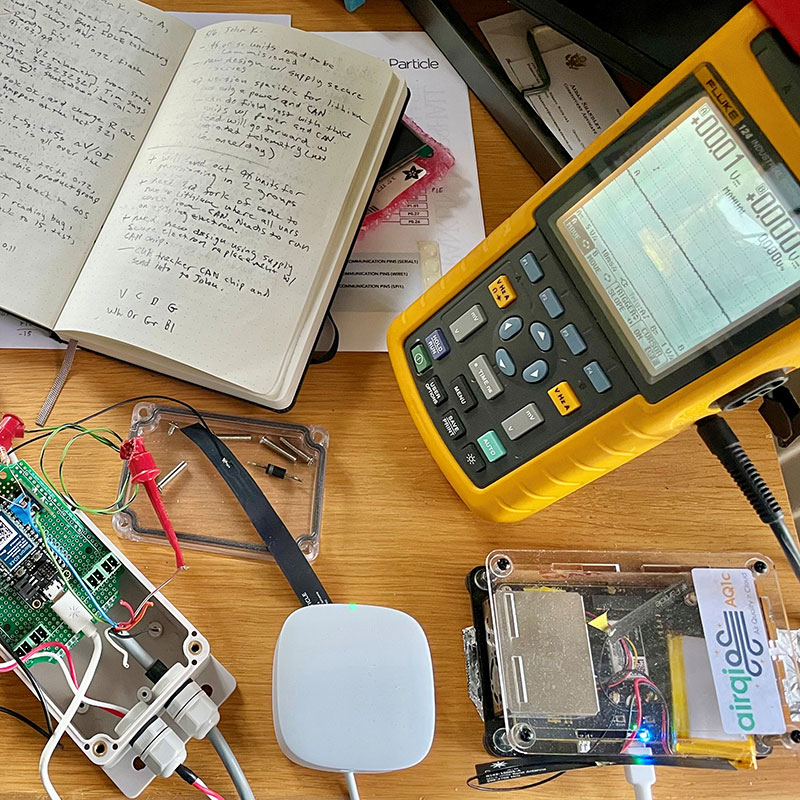
Over the past year, our beta devices have been deployed in homes, offices, schools, and shared spaces. These environments are messy in the best possible way: cooking, cleaning products, occupancy patterns, ventilation habits, and outdoor pollution all interact in ways that are impossible to simulate fully in the lab.
That real-world data has been invaluable. It has helped us:
- Stress-test our sensing stack across diverse environments
- Understand long-term stability
- Identify where algorithms matter more than raw sensor resolution
- Refine what “actionable” air quality information actually means to users
Most importantly, it reinforced a core belief: good indoor air quality insights come from robust systems.
Evaluating MOX Sensors: Sciosense and Sensirion
One of the central technical themes of our beta year has been the evaluation of metal-oxide (MOX) gas sensors, particularly from Sciosense and Sensirion. MOX sensors are attractive tools but they come with challenges: repeatability, environmental dependence, and startup uncertainty.
What We’ve Learned
Through side-by-side testing and long-term deployments, a few patterns became clear:
- Sensor behavior is highly contextual. Temperature, humidity, and airflow matter just as much as the sensor itself.
- Consistency is key. Repeatability and reliable startup are challenging tasks.
- Algorithms are inseparable from hardware. Raw MOX readings are only the starting point; meaningful outputs depend on signal processing, baselining, and environmental compensation.
Both Sciosense and Sensirion sensors have shown strengths in different areas, and our work has focused on understanding how those characteristics translate into reliable indoor air quality insights over months—not days. This evaluation work is ongoing, and it continues to shape how we design our sensing architecture and firmware.
Cost Targets in a Shifting Hardware Landscape
When we started the beta, we set clear cost targets for our devices. Those targets still matter—but the world around them has changed. Two forces have had an outsized impact:
1. Tariffs and Trade Complexity
Global tariffs and shifting trade relationships have increased costs across multiple components, not just sensors. Even when individual price increases are small, they compound across a bill of materials.
2. AI-Driven Chip Demand and Scarcity
The explosive growth in AI has reshaped the semiconductor supply chain. Demand for compute-heavy chips has tightened capacity across fabs, affecting availability and pricing for a wide range of components—including those used in embedded and IoT devices.
The result is a reality many hardware teams face: cost targets are rising, even as expectations for performance, reliability, and longevity increase.
Looking Ahead
As we move beyond the beta phase, the focus is shifting from exploration to refinement:
- Deepening our understanding of long-term sensor behaviour
- Continuing MOX sensor evaluation with a system-level perspective
- Adapting our designs to a changing global hardware ecosystem
- Turning a year of beta data into better, clearer insights for users
Indoor air quality is complex, but the past year has shown us that careful engineering, raw time-series data, and real-world feedback make progress possible. Thank you to everyone who’s been part of our beta journey so far!
Leave a Reply
You must be logged in to post a comment.